
Understand the underlying structure of the determinants of overall job performance evaluation
DOI:
https://doi.org/10.71207/ijas.v8i31.3108Keywords:
The underlying structure, Evaluation of job performanceAbstract
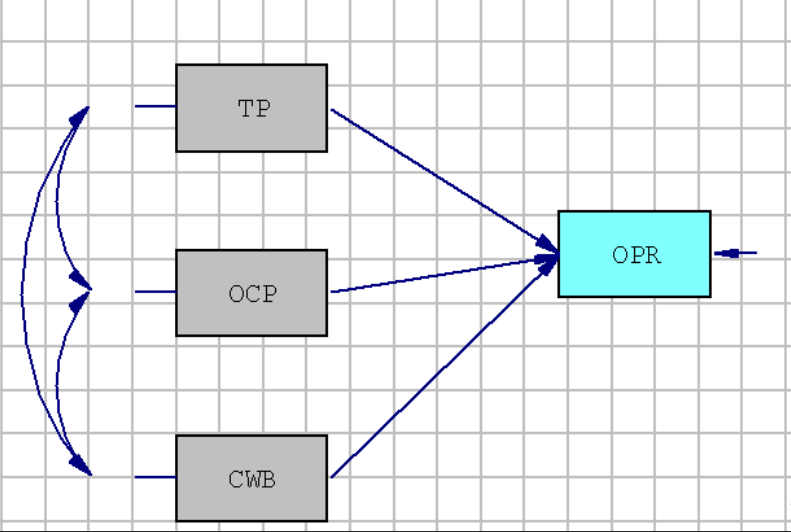
The present research aims to explore content nature of latent structure of antecedents of overall job performance ratings based upon previous researchers\\' notions and opinions in explaining comprehensive multi view for job performance dimensions. This view agrees that job performance for employee includes three main dimensions (task performance, citizenship performance and counterproductive work behavior). Conceptual and empirical purport for this research depend on three key directions. The first direction proceeds to knowing relationship nature among three performance dimensions and overall job performance ratings. The second direction aims to explore relative importance for these dimensions on overall job performance ratings. In the third direction, this research attempts to know interrelationships among these three dimensions. By using structural equation modeling, the research\\'s hypotheses were tested and some of meaningful recommendations were formulated.
Downloads
References
- Befort, N. & Hattrup , K. (2003). Valuing Task and Contextual Performance:
Experience, Job Roles, and Ratings of the Importance of Job Behaviors ,
Applied H.R.M. Research, 2003, Volume 8, Number 1, pages 17-32.
- Bolon, D. S. (1997). Organizational citizenship behavior among hospital
employees: A multidimensional analysis involving job satisfaction and
organizational commitment. Journal of Hospital & Health Services
Administration, 42(2): 221-241.
- Borman, W. C., & Motowidlo, S. J. (1993). Expanding the criterion domain
to include elements of contextual performance. In N. Schmitt, & W. C.
Borman (Eds.), Personnel selection in organizations (pp. 71-98). San
Francisco: Jossey-Bass.
- Borman,W., 2004. The concept of organizational citizenship. Current
Directions in Psychological Science 13 (6), 238–241.
- Byrne, B. M. (1998). Structural Equation Modeling with LISREL, PRELIS,
and SIMPLIS: Basic Concepts, Applications, and Programming. Mahwah,
NJ: Lawrence Erlbaum Associates.
- Campbell, J. P. (1990). Modeling the performance prediction problem in
industrial and organizational psychology. In M. D. Dunnette, & L. M. Hough
(Eds.), Handbook of industrial and organizational psychology (2nd ed., Vol.
, pp. 687–732). Palo Alto, CA: Consulting Psychologists Press.
- Campbell, J. P., Gasser, M. B., & Oswald, F. L.(1996). The substantive
nature of job performance variability. In K. R. Murphy (Ed.), Individual
differences and behavior in organizations (pp. 258-299). San Francisco:
Jossey-Bass Publishers.
- Cascio, W. (2006). Managing human resources: productivity, quality of work
life, profits. Seventh Edition, McGraw. Hall, International Edition.
- Chan, F., Lee, G., Lee, E., Kubota, C., & Allen, Ch., (2007). Structural
Equation Modeling in Rehabilitation Counseling Research, Rehabilitation
Counseling Bulletin, 51:1, 53-66.
- Christensen, R., & Whiting, S. (2009). The Role of Task Performance and
Organizational Citizenship Behavior in Performance Appraisals Across
Sectors: Exploring the Role of Public Service Motivation. International
Public Service Motivation Research Conference, June 7-9, 2009,
Bloomington, IN
- Coole, D. (2003). The Effects of Citizenship Performance, Task Performance,
and Rating Format on Performance Judgments. Unpublished thesis, College
of Arts and Sciences, University of South Florida.12- Costello, A., & Osborne, J. (2005). Best practices in exploratory factor
analysis: four recommendations for getting the most from your analysis.
Journal of Practical Assessment Research & Evaluation, Vol. 10, No 7, 1-9.
- Fox, S. and Spector, P.E. (1999) A model of work frustration-aggression.
Journal of Organizational Behavior, 20, 915-931.
- Fox, S., Spector, P., & Miles, D. (2001). Counterproductive work behavior
(CWB) in response to job stressors and organizational justice: Some
mediator and moderator tests for autonomy and emotions. Journal of
Vocational Behavior, 59, 291–309.
- Giacalone, R. A., & Greenberg, J. (1997). Antisocial behavior in
organizations. Thousand Oaks, CA: Sage Publications, Inc.
- Golob, T. (2001). Structural Equation Modeling for Travel Behavior
Research. Institute of Transportation Studies, University of California,
Irvine; Irvine, CA 92697-3600, U.S.A.
- Griffin, R. W., O'Leary-Kelly, A., & Collins, J. (1998). Dysfunctional work
behaviors in organizations. Trends in Organizational Behavior, 5, 65–82.
- Gruys, M., & Sackett, P. (2003). Investigating the dimensionality of
counterproductive work behavior. International Journal of Selection and
Assessment, 11, 30-42.
- Hewitt AK, Foxcroft DR, McDonald J. Multitrait-multimethod confirmatory
factor analysis of the Attributional Style Questionnaire. Pers Indiv Dic.
;37:1483-91
- Hollinger, R.C., & Clark, J.P. (1982) Formal and informal social controls of
employee deviance. The Sociology Quarterly, 23, 333-343.
- Johnson, E. C., & Meade, A. W. (2010, April). A Multi-Level Investigation of
Overall Job Performance Ratings. Paper presented at the 25th
Annual
Meeting of the Society for Industrial and Organizational Psychology,
Atlanta, GA.
- Kahya, E. (2009). The effects of job performance on effectiveness.
International Journal of Industrial Ergonomics 39, 96–104
- Lievens, F., Conway, J. M., & De Corte, W. (2008). The relative importance
of task, citizenship and counterproductive performance to job performance
ratings: Do rater source and team-based culture Matter? Journal of
Occupational and Organizational Psychology, 81, 11-27.
- Lock , A. (2005). The relationship between individualistic/ collectivistic
orientation and organizational citizenship behavior and the possible
influence of leadership style. Unpublished thesis, Faculty of Social Sciences,
Erasmus University Rotterdam, Turkish.
- MacCallum, P. &Austin, J. (2000). Applications of structural equation
modeling in psychological research. Annu. Rev. Psychol. 51:201–226
- Maccallum, R., & Austin.,J. (2000). Applications of structural equation
modeling in psychological research. Annu. Rev. Psychol. 2000. 51:201–226
- MacKenzie, S.B., P.M. Podsakoff and R. Fetter ‘The impact of
organizational citizenship behavior on evaluations of salesperson
performance’, Journal of Marketing (1993) 57: 70–80.
- Motowidlo, S. J., & Schmit, M. J. (1999). Performance assessment in unique
jobs. In D. R. Ilgen & E. D. Pulakos (Eds.), The changing nature of
performance (pp. 56-86). San Francisco: Jossey-Bass.29- Motowidlo, S. J., Borman, W. C., Schmidt, M. J. (1997). A theory of
individual differences in task and contextual performance. Human
Performance, 10, 71-83.
- Nunnaly, J.C. & Bernstein, I.H. (1994). Psychometric theory. New York:
McGraw-Hill.
- Ones, D. S. (2002). Introduction to the special issue on counterproductive
behaviors at work. International Journal of Selection and Assessment, 10, 1–
- Organ, D. (1990). The motivational basis of organizational citizenship
behavior, Research in Organizational Behavior, 12, 43-72.
- Penney, L. M., & Spector, P. (2002). Narcissism and counterproductive
behavior: do bigger egos mean bigger problems? International Journal of
Selection and Assessment, 10(1), 126–134.
- Peterson, D. (2002). Deviant workplace behavior and the organization's
ethical climate. Journal of Business and Psychology, 17, 47-61.
- Raelin, J. A. (1994). Three scales of professional deviance within
organizations. Journal of Organizational Behavior, 15, 483-501.
- Rego , A. & Cunha , M. (2006) . Organizational Justice and Citizenship
Behaviors: a Study in a Feminine, High Power distance Culture , Submission
of Papers for Publication , University de Santiago. 3810-193 Aveiro.
Portugal.
- Robinson, S. L., & Bennett, R. J. (1995). A typology of deviant workplace
behaviors: A multidimensional scaling study. Academy of Management
Journal, 38, 555–572.
- Rotundo, M., & Sackett, P. (2002). The relative importance of task,
citizenship, and counterproductive performance to global ratings of job
performance: a policy-capturing approach. Journal of Applied Psychology,
, 66-80.
- Van Dyne, Cummings, L., & McLean J., (1995). Organizational citizenship
behavior: construct redefinition, measurement, and validation. Academy of
Management Journal, 37, 765-802.
- Vilela, B., González, J., & Ferrín, P. (2008). Person–organization fit, OCB
and performance appraisal: Evidence from matched supervisor–salesperson
data set in a Spanish context. Industrial Marketing Management 37, 1005–
- Yun, s., Takeuchi, R., & Liu, W. (2007). Employee Self-Enhancement
Motives and Job Performance Behaviors: Investigating the Moderating
Effects of Employee Role Ambiguity and Managerial Perceptions of
Employee Commitment. Journal of Applied Psychology, Vol. 92, No. 3, 745–
Downloads
Published
How to Cite
Issue
Section
License
Copyright (c) 2012 Economics and Administration College - Karbala University

This work is licensed under a Creative Commons Attribution-NonCommercial-NoDerivatives 4.0 International License.
Authors retain the copyright of their papers without restrictions.